
|
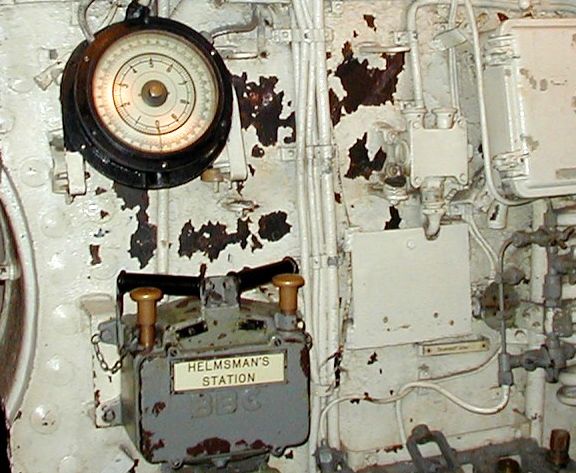
U-505 Control Room Helmsman's Station |
|
We are now facing the forward bulkhead of the control room: the helmsman's station. The helmsman controls
the rudders of the boat. The type IX has two rudders acting in unison, giving an increase of manoeverability
over a single rudder.
At the very right of the photo below is the ladder to the conning tower. Behind us is the
chart table. Here you can clearly see how the museum has cut an access doorway for tourists in
place of the original.
At the very top of this photo you can see what appears to be a large black empty dial or hole. This is the periscope view of the magnetic compass in the conning tower. If the gyroscope was out of action the magnetic compass was used. The conning tower was made of nickel steel and therefore a magnetic compass would work within it, but down inside the boat it would have been next to useless. The compass periscope appears dark because the original mirrors have been removed. |

|
|
In the photo below we can see the gyrocompass repeater as well as the actual controls for the helm. As
you can see the controls are made by the same people that produced the planesmen's controls (see previous
page). In fact it is the same unit, but is wired to electronically control the helm.
There were two more of these controls with identical function for the helm, one situated above in the conning
tower and one up on the bridge. In case of failure of this electrical system there was a manual helm wheel in the
engine room.
|
|
This is clearly incorrect.
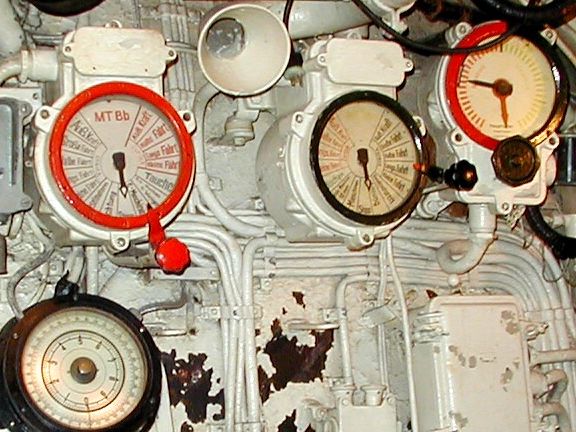
Firstly, The "engine telegraph repeaters" are not repeaters (although the needles (pointers) inside them indicate or 'repeat' the position of the handle of the identical instruments in the engine room), they are the engine room telegraphs, for delivering instructions to engineers in the engine room. The red handle on the red (port) telegraph is connected electrically to the pointer on the port engine's telegraph in the engine room, thus this pointer moves to match the position of the handle in the picture. When it is moved, engine room crew will respond by moving their telegraph's handle to align it with their pointer. That handle is connected electrically to the pointer of the port telegraph in the picture, so follows its position to indicate to the control room crew that the order has been acknowledged. Likewise, the starboard telegraph delivers instructions related to the starboard engine.
Secondly, looking at the picture, it is clear that the "red repeater" (which is in fact the port telegraph) is not "for the diesel engines" because it is marked at its top: MT Bb. Bb is the German abbreviation for Backbord =Port as the writer has explained on this page: http://ubootwaffe.net/u505/cr_ca.html and I'd guess that MT is an abbreviation for Motor Telegraph = Engine telegraph, so the "red repeater" is in fact the telegraph for the port engine (specifically the port screw, i.e. the port diesel engine and the port electric motor, whichever is clutched to that screw) - hence its rim and handle are painted red.
On its right and apparently with its rim and handle painted green although it looks black in the picture, is the telegraph for the starboard engine - again, hence the colour. It is not "a repeater for the electric motors." I would guess that it is marked MT Stb for Starboard Engine telegraph. (Motor Telegraph Steuerbord)
Whoever 'explained' this to the writer has been confused by the six additional instructions in the six segments at the bottom of the telegraph, most of which do not relate to engine speed: the one at the four o'clock position being clearest: Tauchen = Dive whilst the one at five o'clock appears to be E-Maschinen = Electric motors. These additional instructions may or may not all be repeated on the starboard telegraph, to allow space for other orders, but I think I can read Stopp = Stop at the bottom of both telegraphs - obviously essential and Achtung = Stand By on both telegraphs.
Looking at the port telegraph, there appear to be five speed order segments on the left side of the dial for ahead engine orders and four segments with red lettering on the right of the dial for astern engine orders. These segments are shorter than the bottom six segments because, towards the centre, will be the German words for Ahead and astern encompassing all the relevant segments - probably voraus and zurück, as mentioned by the writer on a previous page describing the tachometers above the chart table.
Finally, the engine telegraphs are not "important as the helmsman needs to know what's being asked of the boat." The telegraphs are essential to convey orders from the control room to the engine room. I imagine that a rating would stand beside the helmsman's seat, operating the telegraph handles as instructed by the U-boat's commander or watchkeeping officer.
|
There were also times when quick action by a helmsman could save the boat. For example in the case of a sudden uncontrolled dive the rudders could be put hard over to either port or starboard to act as a brake. There is at least one recorded case of this I've come across.
